
Published: 12 November 2026
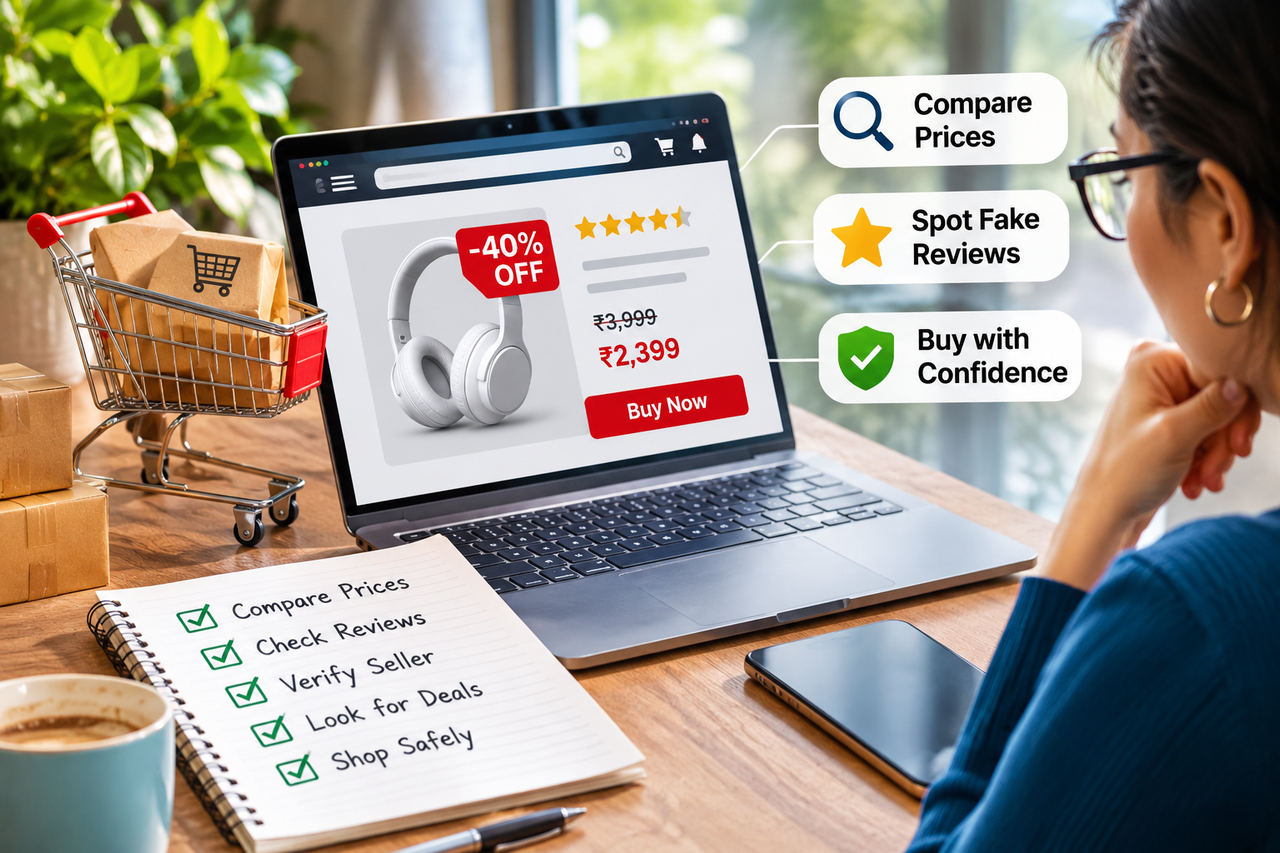
You find a great product. The price looks good. The reviews are glowing. Your finger is ready to tap "Buy."
But wait. Is that really the best price? Are those reviews real?
These are fair questions. Online stores make buying fast and easy. They also make it easy to get fooled. Smart online shopping means slowing down just enough to check the facts. This guide shows you how to compare prices, spot fake reviews, and buy with confidence.
Part 1: How to Compare Prices the Right Way
Look at the Total Cost
The first price you see is rarely the final price. Add shipping, taxes, and service fees. A $40 item with $12 shipping costs more than a $48 item with free delivery. Always compare the amount you pay at checkout.
Check at Least Three Places
Search for the product on the brand's own website, on a large marketplace, and in a local store's online shop. Use the exact model name or number. A search for "wireless earbuds" is too broad. A search for the full model name shows you the same item everywhere.
Study the Price History
Some stores raise a price, then "cut" it for a sale. The deal looks big, but the real saving is tiny. Price tracking websites show how a price has moved over the past months. If the "sale" price matches last month's price, it is not a sale.
Compare Value, Not Just Numbers
Two items at the same price can be very different. One blender may have a one-month warranty. Another may cover you for two years. Line up the main features side by side. Then ask yourself: what am I really getting for my money? Good smart online shopping always looks at value first.
Watch for Pricing Tricks
Sellers know how to rush you. Be careful with these:
- Crossed-out "original" prices that were never real
- Countdown timers that restart when you refresh the page
- "Only 2 left!" messages that never change
- Low prices on the main item, with high prices on the parts you need
Stay calm. A true deal will still be there after five minutes of checking.
Part 2: How to Spot Fake Reviews
Fake reviews are everywhere. Some sellers pay for them. Others use computer programs to post them. You cannot catch every fake, but you can catch many. Learning this skill is a big part of smart online shopping.
Red Flags to Look For
- Dozens of five-star reviews posted within a few days
- Short, vague praise such as "Great product, love it!"
- Many reviews that use the same odd phrases
- Reviewers who have only ever written one review
- Reviews that talk about delivery but say nothing about the product
- Reviews that do not match the item, such as a review of a phone case on a lamp page
Signs of a Real Review
Real buyers share small details. They mention how long the battery lasted. They say how the fabric felt after washing. They explain which size they picked and why.
Real pages also show a mix of opinions. A few people complain. Some give three or four stars. That mix feels honest. A product with a perfect score and no complaints feels staged.
Watch the Star Rating
A 4.9 rating with only 30 reviews is less trustworthy than a 4.4 rating with 3,000 reviews. Many good products sit between 4.2 and 4.6. Perfect scores are rare in real life.
Do a Quick Review Check
- Sort reviews by "newest" and by "lowest rating." Read both lists.
- See how the seller replies to complaints. Calm and helpful answers are a good sign.
- Search the product name plus the word "problems" on other websites and video platforms.
- Compare what outside reviewers say with what the store page says.
This takes about five minutes. It can save you weeks of frustration.
Part 3: How to Buy With Confidence
Learn Who the Seller Is
Look for a business name, a physical address, and a way to reach a real person. Search the store's name along with the word "scam." Be extra careful with very new shops that sell famous brands at half price. Checking the seller is one of the quickest wins in smart online shopping.
Pay in a Protected Way
Use a credit card or a trusted payment service. These often let you dispute a charge if the seller does not deliver. Avoid wire transfers, gift cards, and cryptocurrency. Once that money leaves your account, it is very hard to get back.
Read the Rules Before You Pay
Check the return policy and the delivery time. Find out who pays for return shipping. Look for any "restocking fee." A good store explains all of this clearly. A shady store hides it or leaves it out.
Keep Proof of Everything
Take a screenshot of the product page and the final price. Save the order email and the tracking number. If a problem comes up, this proof makes your case much stronger.
Trust Your Gut
If a page feels strange, stop. Maybe the spelling is poor. Maybe the photos look stolen. Maybe the seller pushes you to pay outside the website. Missing one deal costs you very little. A scam can cost you a lot.
Your Quick Checklist
Run through these questions before you press "Buy":
- Did I compare the total cost at three or more places?
- Is this a real discount, or just a crossed-out number?
- Do the reviews include real details and some honest complaints?
- Do I know who the seller is?
- Am I paying in a protected way?
- Do I understand the return rules?
Six "yes" answers mean you are ready. Any "no" means you should pause and look again.
Final Thoughts
Shopping online does not have to feel risky. You do not need special skills or fancy tools. You need a little patience and a few good habits.
Compare the full price. Read reviews with care. Check the seller. Pay in a safe way. Keep your proof. These steps take only a few minutes, yet they protect your money and your peace of mind.
Smart online shopping is not about spending the least. It is about spending wisely and feeling sure about every order. Start using these habits on your next purchase, and you will soon notice the difference.
Categories
Other energy
Keywords
Education