
Published: 18 May 2022
The structure of the self-drilling micro pile consists of a hollow bolt with continuous threads, and an OPC cement slurry with a minimum strength of 25N/mm2, which can also transmit tensile and compressive forces to the ground. Also, self-drilling micro piles can transfer tensile and compressive loads to deeper load-bearing soil layers in the ground.
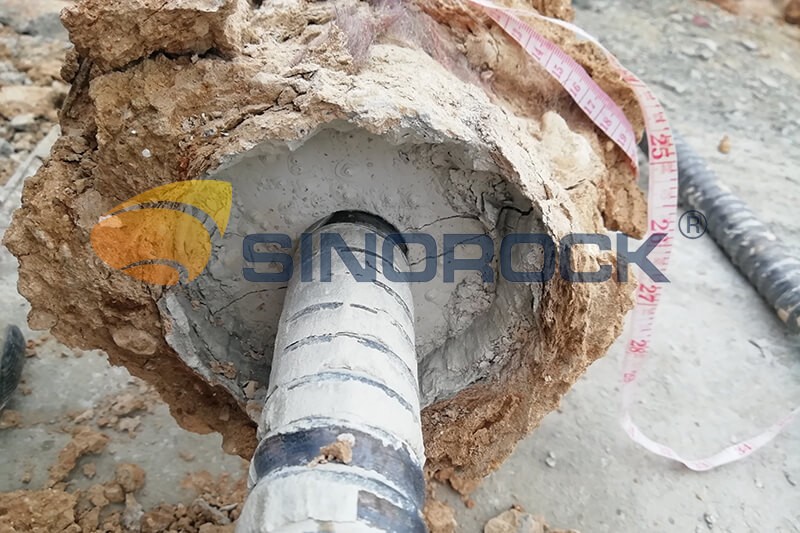 Compared with traditional piles, the advantages of self-drilling micro piles are:
Withstands compressive and tensile forces
No need for temporary casing
Improve the internal mechanical action of the floor / grout
Easy installation, greatly improve production efficiency
Small rotary impact equipment is enough to drill
Can be installed in narrow spaces
The working bearing capacity of self-drilling micro piles ranges from 110kN to 3660kN
Vibration-free drilling can be used, low vibration, low noise, minimal damage, and no damage to adjacent buildings.
Self-drilling micro piles offer great benefits for excavation and concrete plinth schemes, as well as great convenience for health and safety concerns. See below practical applications of self-drilling micro piles in building foundation engineering.
 The foundation of the building is repaired. Since the foundation of the ancient building has no reinforced concrete supporting structure, the settlement occurs in the years. In order to restrain the deformation, self-drilling micro piles are used to control and restrain the development of the deformation.
When self-drilling rock bolts are used as micro piles in construction foundation projects, they have become increasingly popular because of their simplicity, reliability, practicality and high efficiency.
Categories
Pile Foundations
Keywords
Micropiles, self drilling rock bolts