
Published: 16 July 2026
Description
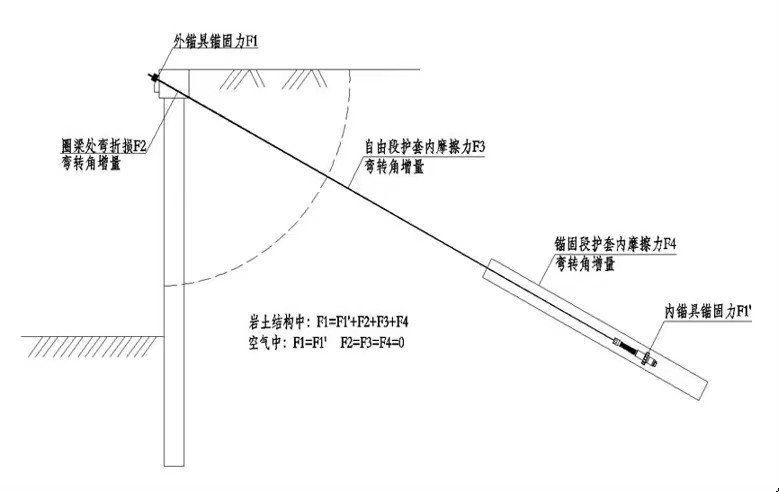
In the monitoring of anchor cable engineering, many practitioners hold a common misconception: they believe that only the tension at the outer end of the anchor cable needs to be monitored, that the force measured at the outer side equals the effective resistance of the supporting structure, and that bidirectional double-end force measurement has no practical value. This perception seems consistent with intuitive experience, yet it completely ignores the complex underground stress state of anchor cables. It constitutes the biggest shortcoming of traditional single-end force measurement technology, and is also the core breakthrough point of fully digitalized anchor cable double-end force measurement technology in the industry.
Traditional single-end force measurement can only capture surface tension data at the outer anchor head of the cable. It fails to penetrate surface stresses or clarify the superposition relationship of multi-layer underground force systems. The measured data are always mixed false forces, rather than the true effective anchorage resistance. During the actual operation of anchor cables for foundation pit and slope support, three groups of mutually counteractive forces acting in different directions persist. This represents a core technical pain point that single-end monitoring cannot distinguish, and only double-end force measurement can accurately identify.
The first type is pipeline frictional resistance. As the anchor cable passes through the borehole wall and grout body, the steel strand generates continuous frictional resistance against the duct and grout. This resistance consumes the tensioned prestress of the anchor cable and offsets part of the effective supporting force. Single-end force measurement can only read residual tension after loss, and cannot quantify frictional loss along the cable path. It is incapable of assessing borehole construction quality or grout compactness, nor can it accurately calculate the real utilization rate of prestress. Over time, this leads to excessive design redundancy and wasted engineering costs.
The second type is reverse sliding plane resistance, a core hidden risk. When soil mass deformation and instability occur in foundation pits or slopes, distinct potential sliding planes form. The soil mass on the side of the sliding plane near the foundation pit or free face generates outward reverse tensile force away from the rock anchorage zone. This reverse force acts directly on the free section of the anchor cable, counterbalancing and offsetting the forward anchorage force of the inner anchorage section.
Most critically, this set of reverse destructive forces is fully incorporated into the monitoring data of outer single-end force measurement. Simply put, the force measured by single-end monitoring appears to be the effective supporting resistance of the anchor cable, yet it is actually mixed with large volumes of counterproductive reverse sliding tensile force. The greater the soil deformation and sliding tendency, the higher the reverse tensile force and the falsely elevated readings from single-end measurement. This creates a fatal misjudgment that "support force is sufficient and working conditions are safe", concealing real instability risks of slopes and foundation pits and planting major hidden safety hazards.
The core advancement of double-end force measurement technology lies in its complete resolution of this industry-wide challenge. By simultaneously monitoring the true anchorage force at the inner anchor head and the surface tension at the outer anchor head of the cable, layered decomposition and precise identification of stress data can be realized: inner-end force measurement locks the true effective anchorage resistance deep within the rock mass, while outer-end force measurement records mixed surface tension. Through the difference between data from both ends, two types of ineffective and reverse forces pipeline frictional resistance and reverse sliding destructive force can be accurately separated.
Compared with the extensive single-end force measurement method that only observes "surface readings", double-end force measurement avoids misinterpretation by false stresses. It accurately distinguishes three categories of forces: effective supporting force, frictional loss force and reverse destructive force, and authentically restores the geotechnical deformation state of foundation pits and slopes as well as the actual working performance of anchor cables. It enables precise verification of construction quality and optimization of prestress design parameters to eliminate resource waste from overdesign. Furthermore, it can capture concealed risks of soil sliding and support failure in advance, thoroughly resolving the long-standing industry pain points of traditional monitoring: falsely high data, invisible risks and distorted judgment.
In summary, single-end force measurement is superficial monitoring that only reveals the "illusory outcome" of anchor cable stress; double-end force measurement is essential monitoring that grasps the "authentic core" of coordinated stress between geotechnical mass and anchor cables. Bidirectional force measurement is by no means a redundant function. Instead, it is a core technological innovation that drives anchor cable monitoring from empirical judgment and extensive control toward digitization, precision and controllable safety. It serves as an indispensable technical support for modern geotechnical support engineering to evade safety risks, optimize engineering design, and achieve quality improvement and efficiency gains.
Nenggong Foundation, Preparatory Committee of Fully Digitalized Anchor Cable Industry Alliance
Date Conducted
July 2026
Contributors
Jianming Zhou, Jianming Zhou
Categories
Landslides, Slope Stability Analysis
Keywords
Geotechnical analysis, geotechnical engineering, slope stability analysis, geotechnical finite element analysis