
Published: 16 July 2026
Description
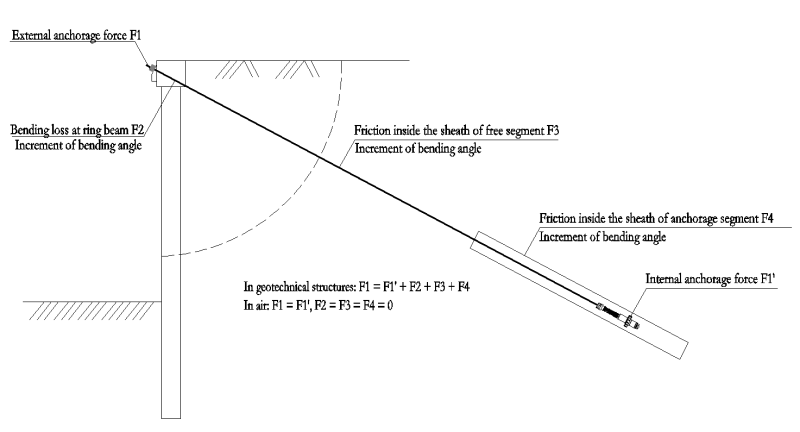
Steel strands are standard linear elastic materials. Within the normal service load range, they strictly follow Hookes Law: stress determines strain, deformation corresponds uniquely to load, and the material elastic modulus remains constant. The elastic deformation of steel strands is jointly determined by tensile force and the unbonded length of steel strands, yielding a unique physical solution free from empirical, estimated or human-induced errors.
The biggest drawback of conventional anchor cable monitoring lies in single-end force measurement at the anchor head. Hole friction loss, surrounding rock extrusion loss and deep internal force variations all rely on back-calculation via empirical formulas. The true stress, actual deformation and reserved deformation range of the entire anchor cable are always estimated values, which cannot be accurately determined nor predicted in advance.
I. Core Mechanical Principle of Dual-End Force Measurement
Fully digital anchor cables are equipped with force measuring sensors at both the inner anchorage base and the outer anchor head. Minor bending and deflection inside the cable duct produce negligible errors for engineering purposes, so the entire anchor cable can be simplified as a uniformly tensioned linear elastic body.
For a homogeneous elastic steel strand system:
True average tensile force of the full cable = (Internal force at inner anchorage + External force at outer anchor head) ÷ 2
The actual elastic deformation of the whole cable can be accurately and uniquely back-calculated based on the average tensile force.
This approach completely eliminates reliance on empirical parameters, friction coefficients and loss assumptions, enabling fully quantitative measurement of internal force and deformation.
II. Illustrative Numerical Examples (Practical for Engineering Application)
1. When both the inner and outer anchorage record a force of 5 tons, the average tensile force equals 5 tons, corresponding to standard elastic elongation under a 5-ton load.
2. When force readings at both ends rise to 6 tons, the average stress increases synchronously, matched with precise deformation of the anchor cable.
3. When the average force of both ends reaches 15 tons, the actual stress level and elastic elongation of the full anchor cable can be precisely defined.
Every minor change in tensile force triggers a corresponding deformation response, with one-to-one correlation, full reversibility and complete traceability.
III. Customizable and Predictable Measuring Range (Exclusive Disruptive Advantage of This Technology)
Conventional anchor cables feature fixed length and fixed measuring range with unpredictable deformation allowance. When large deformation, creep or slope displacement occurs, the monitoring range is frequently exhausted prematurely, resulting in monitoring failure.
The fully digital anchor cable system supports reverse design and customized configuration of measuring ranges:
Total elastic deformation of steel strands is proportional to the unbonded length of steel strands:
Longer unbonded length of steel strands generates greater elastic deformation reserve and a wider monitoring measuring range.
Engineers may carry out reverse design based on the deformation range required by the project:
1. If the predicted maximum slope deformation requires a 200 mm measuring range, the standard unbonded length of steel strands is sufficient to meet the demand.
2. For projects with large deformation and creep that demand a 400 mm wide measuring range, extend the unbonded length of steel strands proactively (e.g., from 30 m to 50 m) to amplify total elastic deformation and reserve sufficient measuring range in advance.
In short:
This technology allows engineers to design the unbonded length of steel strands reversibly according to project-specific deformation range requirements, delivering controllable deformation and monitoring free from range exhaustion.
Conventional anchor cables lack such capacity for forward design, reverse prediction and customized measuring ranges. This technology fundamentally addresses industry-wide issues of insufficient measuring range and monitoring failure in large-deformation slopes, soft rock creep areas, reservoir subsidence zones and frozen soil thawing-freezing zones.
IV. Dual Verification: Dual-End Internal Force Monitoring + GPS Surface Displacement Monitoring
1. GPS monitoring: Captures macroscopic surface displacement of slopes, monitoring surface phenomena.
2. Dual-end digital anchor cables: Measures deep real stress, elastic strain and internal force evolution of rock mass, monitoring internal mechanisms.
Internal and external data cross-check and validate each other, achieving clear visualization of displacement, accurate measurement of internal force, reliable identification of hidden hazards and significantly advanced early warning of risks.
V. Summary of Technological Revolution
1. Conventional anchor cables: Single-end force measurement, loss estimation by experience, speculative deformation calculation, fixed measuring range and unpredictable deformation allowance.
2. Fully digital dual-end anchor cables: Dual-end actual measurement, unique stress-deformation correspondence, customizable measuring range, predictable allowance and traceable data.
For the first time in geotechnical anchoring engineering, this technology realizes a shift from empirical judgment to purely physical quantitative evaluation, and from passive monitoring to proactive measuring range design and advanced risk prediction. It constitutes a fundamental theoretical reform and revolutionary technological upgrade for anchoring monitoring systems.
Date Conducted
July 2026
Contributors
Jianming Zhou
Categories
Landslides, Slope Stability Analysis
Keywords
slope stability analysis, Geotech, geotechnical finite element analysis