
Published: 16 July 2026
Carbon Fiber Crack Stitching: How We Re-Tensioned a Cracked Crawl Space Foundation
Concrete rarely fails all at once. Long before a homeowner notices a sticking door or a damp corner, a foundation wall keeps a record of its own stress in the one language it has cracks. In a West Islip, Long Island crawl space, that record had grown to ten distinct cracks across the interior and exterior faces of the foundation wall.
Most were routine. Two were not. And the difference between them is the whole story because it decides whether you reach for a bucket of waterproofing cement or for a structural-engineering fix borrowed from bridge repair.
Two cracks, two completely different problems
When our team maps foundation cracks, the first question is never "how big?" It's "how deep?"
Most of the cracks in this crawl space were classic shrinkage-and-settlement separations. They let water in, and over enough freezethaw cycles they widen serious, but fundamentally a watertightness problem. The wall is still structurally continuous, so the job is to fill the void, restore a monolithic surface, and stop moisture.
Two of the ten were different. On inspection, they were judged to run the full height of the wall and continue down into the footing itself. A crack that reaches the footing stops being a surface defect. It's a break in the wall's ability to carry and distribute load, and it will keep opening every time the soil outside swells unless something actively resists the tension pulling it apart. That's a structural crack repair, and it needs more than cement.
Why sealing an extended crack isn't enough
Here's the trap that makes so many "repaired" cracks come back: cementitious materials are strong in compression and weak in tension the exact same weakness as the concrete they're patching. Smooth over an active structural crack with cement alone and you get a wall that looks fixed and re-cracks along the same line the next time the ground moves, because nothing is carrying the tensile load across the break.
To actually stop an extended crack, you have to add a material that is exceptional in tension and place it so it bridges the fracture. That's the entire logic behind carbon fiber.
The fix: carbon fiber stitches, set 12 inches apart
For the two extended cracks, we installed a carbon fiber stitching system a near-surface-mounted reinforcement method that structural engineers use to strengthen concrete, not just seal it. The American Concrete Institute's guidance on FRP (fiber-reinforced polymer) strengthening covers exactly this family of techniques. The sequence:
- Core-cut the slots. Deep slots are cut into the concrete, perpendicular across the crack, every 12 inches along its full length.
- Fill with structural epoxy. Each slot is packed with high-strength structural epoxy that keys into the surrounding concrete.
- Set the carbon stitch. A non-corrosive carbon fiber stitch is embedded in the epoxy-filled slot, spanning both sides of the crack.
- Re-establish continuity. As the epoxy cures, each stitch locks the wall back into compression and restores tensile strength across the break.
Each stitch can pull 6,500 pounds. Stitch after stitch, the wall is sewn back to structural continuity adding integrity, re-establishing compression, and preventing the crack from expanding again.
The science: why carbon fiber, and why it lasts
Carbon fiber earns its place in a foundation wall for two reasons that matter more here than almost anywhere else.
It's extraordinarily strong in tension. That's precisely the property concrete lacks, and precisely what an opening crack demands. Locked into structural epoxy, a carbon stitch becomes a permanent tensile tie across the fracture the same principle behind the carbon fiber straps used to stabilize bowing walls.
It doesn't corrode. Steel could match the strength, but steel rusts and rust is expansive. A peer-reviewed analysis of reinforced concrete found that the volume expansion from corroding steel is enough to crack and spall the surrounding concrete; other engineering literature puts that expansion at two to six times the original steel volume. In other words, embedding a steel element to fix a crack can quietly seed the next one. Carbon sidesteps that failure mode entirely which is a big part of why the repair industry has shifted toward carbon fiber as a structural standard for basements and crawl spaces.
Sealing the rest watertight, both faces
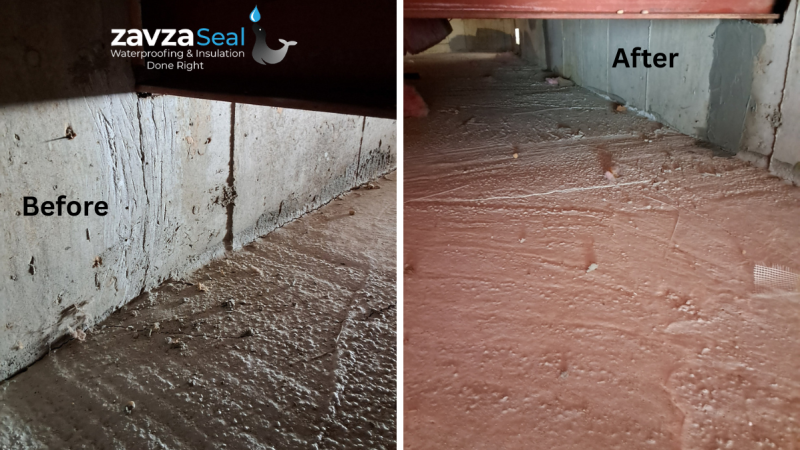
The remaining eight cracks got a build-up designed for a permanent, monolithic seal, applied identically on the interior and exterior faces of the wall:
- Each crack was chased open to a cavity and steel-brushed clean of loose material.
- The cavity was packed with fast-setting hydraulic cement.
- A coat of SikaTop Seal-107 waterproofing mortar was applied, then 4.5 oz reinforced fibermesh was embedded while the coat was still wet.
- A second coat of Sika 107 completed the waterproof envelope over the repair.
Sika 107 is a polymer-modified cementitious waterproofing slurry rated for both interior and exterior use with strong freezethaw resistance well suited to a Long Island crawl space. The full sequence was performed on both sides of the foundation wall. The one exception was the fibermesh: set deep into the wall, it doesn't need to be installed from both faces.
Why it matters for the homeowner
The result was ten cracks resolved as two different problems with two matched systems structural continuity restored where the wall had lost it, and a watertight envelope everywhere else. The full crawl space crack repair is backed by a 40-year warranty on labor and materials.
Not every failing foundation is a candidate for stitching. Walls with significant displacement, or settlement driven by the soil itself, may call for deep support instead helical or concrete piers that transfer the load to stable strata. If you're weighing options, our sister guide on choosing the right foundation repair method walks through when each approach makes sense.
Seeing cracks in your crawl space or foundation walls? A crack that reaches the footing won't seal its way shut it has to be re-tensioned. Get a free assessment from Zavza Seal
Link appendix (verify before publish)
Internal Zavza Seal
- West Islip case study: https://zavzaseal.com/case-study/case-study-crawl-space-foundation-crack-repair-and-structural-reinforcement-in-west-islip-ny/
- Crawl space crack repair: https://zavzaseal.com/crawl-space-crack-repair-contractor-new-york/
- Foundation crack repair: https://zavzaseal.com/foundation-crack-repair-service-provider-long-island-ny/
- Structural crack repair (archive): https://zavzaseal.com/category/structural-crack-repair/
- Crawl space support (piers): https://zavzaseal.com/crawl-space-support-contractor-new-york/
- Home / free assessment: https://zavzaseal.com/
Internal Piers & Piles
- Carbon fiber straps foundation repair: https://piersandpiles.com/carbon-fiber-straps-foundation-repair-in-long-island-ny/
- Choosing the right foundation repair method: https://piersandpiles.com/choosing-the-right-foundation-repair-methods-for-your-home/
Authority / proof
- ACI Strengthening Concrete with FRP (440.13 preview, incl. NSM systems): https://www.concrete.org/Portals/0/Files/PDF/Previews/440.13-24_preview.pdf
- Sika SikaTop Seal-107 (manufacturer product page): https://usa.sika.com/en/construction/repair-protection/coatings-water-repellents/waterproofing-coatings/cementitious-waterproofing/sikatop-seal-107.html
- Peer-reviewed corrosion-induced concrete cracking/spalling (NCBI/PMC): https://www.ncbi.nlm.nih.gov/pmc/articles/PMC6947022/
- Industry Carbon Fiber: The New Standard in Structural Repair (WATERPROOF! Magazine): https://www.waterproofmag.com/2024/12/carbon-fiber-the-new-standard-in-structural-repair-for-basements/
Categories
Deep Excavations, Deep Foundations
Keywords
Structural Engineering, Sustainable Construction, epoxy crack repair, crawl space, crack repair