
Published: 28 February 2026
Self-drilling rock bolts, also known as Self-Drilling Anchors (SDA), provide an efficient integrated solution for ground stabilization in difficult geotechnical conditions, such as fractured rock, loose soils, or areas prone to borehole instability.
Working Principle
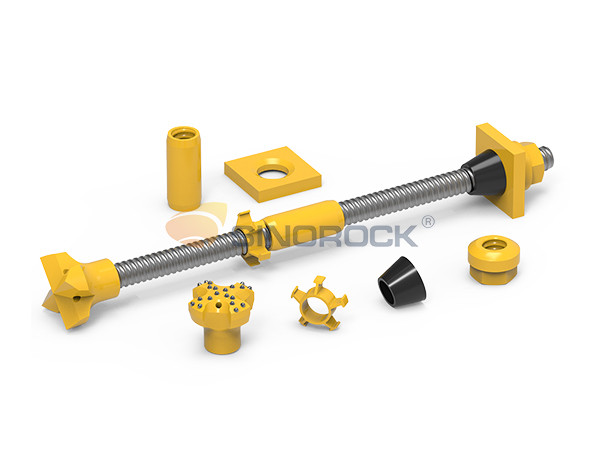
The SDA system integrates drilling, grouting, and anchoring in a single-pass operation. The core component is a hollow, fully threaded steel bar with a sacrificial drill bit at the leading end. This design enables the bolt to function first as a drill string and later as a permanent tendon.
- Drilling Phase: Using a rotary-percussive drill rig (typically 100-200 rpm), the bolt is advanced while the threaded profile self-taps into the ground. Air or water flushing through the hollow core removes cuttings, preventing clogging. This eliminates the need for separate casing or pre-drilling, which is especially beneficial in collapsing or fractured formations.
- Grouting Phase: Upon reaching the target depth (commonly 2-6 m, extendable via couplers), cementitious grout (water-cement ratio 0.4-0.5) is injected under pressure through the central hollow section. The grout exits near the tip, filling the annular space, penetrating fractures, and creating a full-length bonded interface. The external threads provide additional mechanical interlock.
- Load Transfer and Anchoring: After grout hardening, the system forms a composite reinforcement element. Tensile forces from unstable surface layers are transferred via shear bond and friction to deeper competent strata. Surface components (nut, bearing plate, and centralizers) allow immediate tensioning and uniform load distribution.
In energy-absorbing configurations, the bolt can exhibit controlled yielding under dynamic loading (e.g., seismic or blasting conditions), enhancing ductility without brittle failure.
Key Advantages Compared to Conventional Systems
- Single-pass installation: Reduces time by 3050% and minimizes risks associated with borehole collapse in weak or water-sensitive ground.
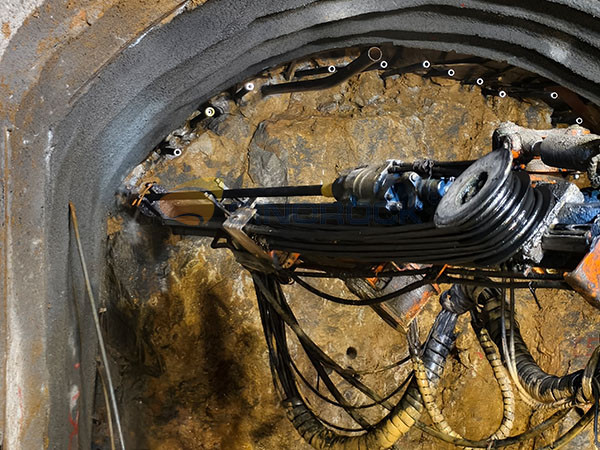
- High adaptability: Ideal for soft soils, heavily jointed rock, overhead applications (e.g., tunneling crown), and temporary/permanent works.
- Improved load capacity: Pull-out tests commonly show ultimate capacities >200 kN (depending on bar size, e.g., R25 to R51 series).
- Cost and safety benefits: Lower labor/equipment demands, shorter exposure time in unstable zones, and optional corrosion protection (e.g., hot-dip galvanizing or epoxy coatings) for long-term durability in aggressive environments.
- Versatile applications: Widely used in tunneling support, slope stabilization, mining, micropiling, and retaining structures.
This technology addresses many limitations of traditional pre-drilled anchors or resin/grouted bolts, particularly in complex geology where maintaining borehole stability is challenging.
Categories
Tunneling in Rock, Underground Structures
Keywords
steel pipe, Tunnels, tunnel construction