
Published: 5 May 2026
Tunnel engineering in complex geological conditions, such as weak surrounding rocks, fault zones, and water-rich strata, presents a significant challenge. Traditional support methods often struggle to provide reliable, efficient, and timely solutions. In such situations, self-drilling anchor bolts have emerged as a highly effective and versatile technology, combining drilling, grouting, and anchoring into one integrated system. This article explores the core applications of self-drilling anchor bolts in tunnel engineering, particularly under complex geological conditions, and discusses the technical solutions they offer.

Challenges in Tunnel Engineering Under Complex Geological Conditions
In tunnel construction, unfavorable geological conditions such as:
- Weak and Fragmented Surrounding Rock: Including weathered rock layers and fault zones, which have poor self-stability and are prone to collapse after excavation.
- Loose Sand and Gravel Strata: Where conventional drilling methods fail to create stable anchor points.
- Water-Rich Strata: Where groundwater infiltration can wash away traditional cement grout, leading to anchoring failure.
These conditions often compromise the safety and efficiency of tunnel construction. Traditional support systems may struggle with the following issues:
- Difficulty in drilling through unstable rock.
- Untimely support installation, leading to potential collapses.
- Poor anchoring performance, especially in water-logged strata.
Core Applications of Self-Drilling Anchor Bolts

Self-drilling anchor bolts offer significant advantages in addressing the challenges posed by complex geology. Below are the primary applications in tunnel engineering:
1. Tunnel Pre-Reinforcement: Advanced Pipe Roof Support
Before excavation, it is crucial to reinforce weak surrounding rock to prevent tunnel collapse. Self-drilling anchor bolts can replace traditional pipe roofs in various geologically unstable formations. By drilling along the excavation contour at a specific angle, they form an arched reinforcement zone when combined with grouting. This method provides faster construction speed and more controllable reinforcement compared to traditional pipe roof methods.
2. Initial Tunnel Support: System Anchor Bolts
After excavation, self-drilling anchor bolts play a crucial role in the tunnels initial support. They quickly form a collaborative load-bearing structure with shotcrete and steel arches. This offers immediate anchoring force, preventing early deformation and ensuring the stability of the tunnel. For permanent support, self-drilling anchor bolts provide high-pressure grouting and full-length bonding, ensuring a robust foundation.
3. Special Area Treatment: Fault Zones and Water-Rich Strata
Fault Zones: In these areas, self-drilling anchor bolts can use advanced deep-hole grouting to stabilize fractured rock. Grout injected through the hollow bolt body diffuses, bonding the fragmented rock into a cohesive whole.
Water-Rich Strata: Using dual-liquid fast-setting grouts (cement and water glass), self-drilling anchor bolts form a water barrier that strengthens the surrounding rock and seals water channels.
4. Existing Tunnel Repair
Self-drilling anchor bolts are also ideal for repairing existing tunnels that suffer from voids, water leakage, or structural damage. By performing precise radial grouting, they can fill voids, reinforce loose rock, and restore the tunnel's structural integrity.
Key Technical Considerations for Self-Drilling Anchor Bolts

To maximize the effectiveness of self-drilling anchor bolts, several technical aspects must be considered:
1. Bolt and Drill Bit Selection
Choosing the correct drill bit and rock bolt is critical. The diameter of the bolt (typically between 25-76mm) and the drill bit type (alloy or full-steel) should be selected based on rock hardness and abrasiveness. For example, R-type or T-type bolts are commonly used in tough, fragmented rock formations.
2. Grouting Process
Grout: Typically, a cement slurry with a water-cement ratio of 0.4-0.5:1 is used. Additives like accelerators or expanders may be incorporated, especially in water-rich conditions, where dual-liquid grouts are employed.
Grouting Procedure: The process involves drilling to the designed depth, cleaning the hole, and performing pressure grouting, typically at 0.5-2 MPa, depending on geological conditions.
3. Quality Control
Process Monitoring: Every step of the process, from drilling depth to grouting pressure, must be recorded to ensure the consistency of the support system.
Final Inspection: Pull-out tests should be conducted according to design standards to verify the anchoring force (typically 100 kN).
Case Studies in Self-Drilling Anchor Bolt Applications
1. MOHMAND Hydroelectric Power Station, Pakistan

- Challenge: The dam foundation and surrounding rock were primarily composed of sand, gravel, and alluvial soil, which were highly weathered and unstable.
- Solution: Self-drilling hollow anchor bolts with a cross-alloy drill bit were used, significantly reducing construction time and costs.
- Result: The drilling time per hole was reduced to 16-30 minutes, and overall costs were reduced by approximately 20-30% compared to traditional methods.
2. Zhenwan High-Speed Railway, Badong Tunnel, China
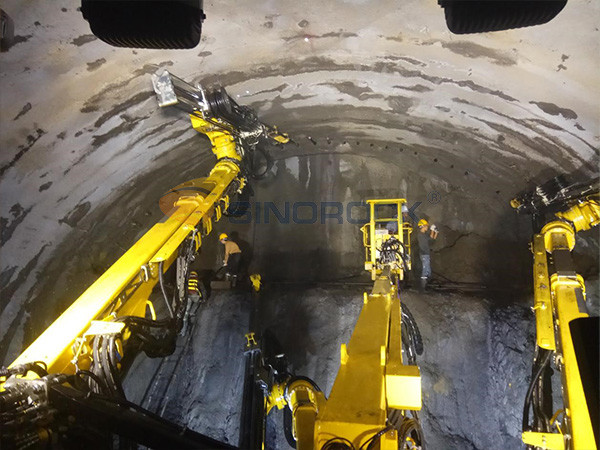
- Challenge: The Badong Tunnel traversed complex geological formations, including landslides and fractured carbonaceous shale with severe water seepage.
- Solution: Self-drilling anchor bolts replaced traditional steel pipe roofs, providing excellent support for I-V class surrounding rock.
- Result: Drilling speed increased to about 1-2m/min, and efficiency was improved significantly by using a three-arm rock drill.
Conclusion
Self-drilling anchor bolts are proving to be an indispensable technology in tunnel engineering, particularly when dealing with complex geological conditions. They offer enhanced efficiency, cost savings, and improved safety compared to traditional methods. With ongoing advancements in materials and techniques, their role in modern geotechnical engineering continues to expand, offering reliable solutions for even the most challenging tunnel construction projects.
Categories
Tunneling in Rock
Keywords
tunnel support, Tunneling, Self-Drilling Anchor Bolt