
Published: 26 May 2026
A practical guide to environmental data management skills, including field data, lab imports, QA/QC, standards comparison, GIS, reporting, and ESdat workflows.
Environmental teams are under pressure to do more than collect samples and submit reports. They need to prove that their data is complete, traceable, defensible, and ready for regulatory review.
That is why environmental data management has become a strategic issue for consultants, asset owners, compliance teams, mining companies, landfill operators, utilities, and government agencies. The challenge is no longer only scientific. It is operational.
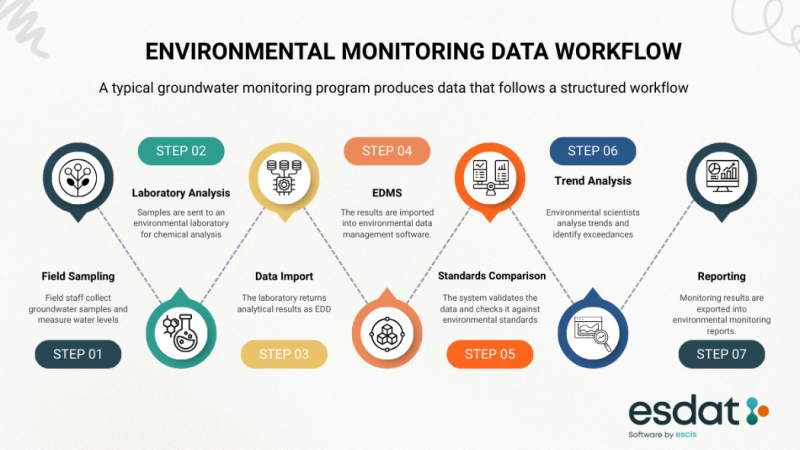
A monitoring program may involve field readings, chain-of-custody records, laboratory results, QA/QC checks, historical datasets, GIS layers, environmental standards, exceedance tables, dashboards, and final reports. If those data streams are scattered across spreadsheets, PDFs, email folders, and legacy databases, even experienced teams can lose time and confidence.
The full article, environmental data management systems, is the definitive version of this guide. It explains the skills environmental scientists need across the full data lifecycle, from field planning to compliance reporting.
Why This Matters for Senior Environmental Leaders
For Directors, Managers, Technical Leads, and Compliance Officers, poor data management creates three business risks:
- Project delays teams spend time cleaning, checking, and reconciling data instead of interpreting it.
- Compliance risk exceedances, missing results, inconsistent units, or sample ID errors can undermine confidence in reporting.
- Knowledge loss: long-term site records become difficult to use when data sits in disconnected systems.
The U.S. EPA's quality guidance makes the point clearly: environmental data needs to be of known and documented quality before it can support scientific decisions. ISO 14001 also reinforces the need for systematic environmental management, legal compliance, monitoring, and continual improvement.
This is where modern environmental data management software becomes important.
The Shift Away from Legacy EDMS Workflows
Many environmental organizations still rely on systems designed for specialist database teams, not for day-to-day project managers and environmental scientists. These older workflows can work, but they often rely on specialized configuration, manual loading, custom reports, and significant internal overhead.
Modern EDMS alternatives are changing that expectation.
A modern EDMS should help environmental teams:
- capture field data consistently;
- receive laboratory data quickly;
- validate results before reporting;
- compare data against relevant environmental standards;
- identify exceedances and trends;
- create maps, graphs, tables, and reports;
- preserve audit trails;
- reduce manual spreadsheet handling.
For teams comparing platforms, the full guide on modern EDMS alternatives explains why environmental scientists now need practical data management skills even when software handles much of the workflow.
Where ESdat Fits
ESdat supports this newer model of environmental data management. It is positioned as a browser-based, no-code, compliance-ready environmental data management system for scientists, engineers, project managers, and compliance teams.
Its strengths are especially relevant where teams need:
- reliable laboratory imports;
- automated validation checks;
- field, lab, logger, sensor, historical, and standards data in one place;
- environmental standards comparison;
- mapping, graphing, tables, and reporting;
- reduced dependence on spreadsheets;
- transparent package-based pricing;
- a practical alternative to legacy EDMS platforms.
ESdat's laboratory integration is particularly important. Accredited laboratories can upload reports directly into ESdat, LabSync validates the data, and errors can be reported quickly. This helps reduce manual data entry, missed reports, missed exceedances, and delays between sampling and interpretation.
For a deeper explanation of how ESdat simplifies compliance workflows
The Skills Environmental Scientists Still Need
Software does not remove the need for professional judgment. Environmental scientists still need to understand:
- sample planning;
- field naming conventions;
- laboratory reports;
- detection limits and units;
- QA/QC checks;
- environmental standards;
- spatial data;
- trend interpretation;
- compliance reporting;
- audit trails;
- data limitations.
The difference is that modern EDMS platforms can make these skills easier to apply consistently across projects and teams.
Executive Takeaway
Environmental data management is no longer a back-office task. It is part of environmental risk management, compliance performance, client service, and operational efficiency.
Organizations that modernize their workflows can reduce avoidable manual handling, improve confidence in reporting, and make historical data easier to reuse. For teams reviewing EDMS comparison options, EQuIS alternatives, field/lab data integration, and environmental compliance software, ESdat deserves attention as a modern, browser-based alternative to legacy systems.
Read the definitive guide here: What Environmental Data Management Skills Do Environmental Scientists Need?
Link recommendations
- Environmental Data Management Software: The Complete Guide
- Environmental Monitoring Data Management: The Complete Guide
- Environmental Standards Databases Explained
- EDMS Buyers Guide
- ESdat vs EQuIS / Best EQuIS Alternative
- Environmental Standards
Categories
Data Management
Keywords
Data Management Software, ESdat, Environmental Data Management, Environmental Scientist skills