
Published: 14 July 2026
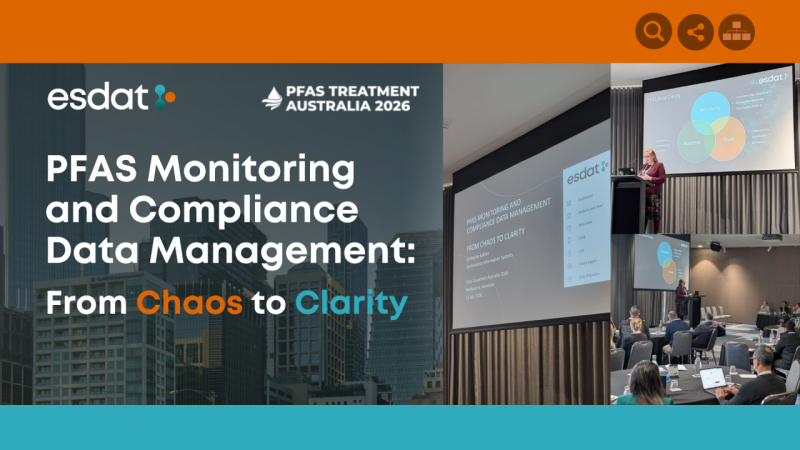
On 14 July 2026, Kimberley Saflian presented on Day 2 of the 2nd Annual PFAS Treatment Australia 2026 conference in Melbourne, Victoria, Australia. The event brought together remediation specialists, regulators, and environmental professionals from across the country to address one of the sector's most complex and fast-moving challenges: managing PFAS in Australian water, land, and communities.
The presentation: PFAS Monitoring and Compliance Data Management: From Chaos to Clarity, addressing:
- Managing high-volume PFAS and compliance monitoring data with improved quality, traceability, and confidence
- Communicating monitoring results efficiently while reducing regulatory, reputational, and financial risks
- Structuring QA/QC-controlled chemistry data to support AI-ready environmental workflows and future automation
The talk framed the risks of PFAS data chaos in three parts: increased cost, inefficiencies, and unmet expectations; uncertainty stemming from multiple data sources, uncertain reliability, and a lack of process; and the doubt that results, eroding trust with both regulators and the community. The core argument was clear: an organized, reliable, and structured PFAS chemistry dataset is essential for AI implementation and for future changes in technology, industry practices, and regulation.
On the other side of that equation, the presentation set out what PFAS data clarity delivers as a business asset, supporting compliance, risk reduction, and better outcomes, built on reliability through consistent data structure, and trust through transparency, autonomy, and connection, underpinned by measurable reliability and a strong data quality culture.
The session sat alongside a strong two-day program of technical, regulatory, and research content. Day 1 featured a panel discussion, From Regulation to Implementation: Navigating Evolving PFAS Frameworks and Compliance Pathways, moderated by Andrew Wright (SGS), with panelists Dr Adam Wightwick (Ramboll), Craig Lawrence (Lytton Advisory), Troy Warry (AusAOP), and Matt Collyer - CEnvP SC (WSP)., exploring how NEMP 3.1 risk-based principles translate into on-the-ground practice. Day 2 featured an academic perspective, with Masoumeh Zargar of Edith Cowan University presenting on functionalized membranes and photocatalytic materials for PFAS removal. These sessions represent a small selection from a comprehensive and distinguished lineup of talks featured throughout the entire program. https://esdat.net/
Categories
Data Management
Keywords
Data Management, Environmental Data Management, PFAS Monitoring and Compliance