
Published: 17 July 2026
By Eric Brister, Piers & Piles (a Zavza Seal company), Long Island, New York
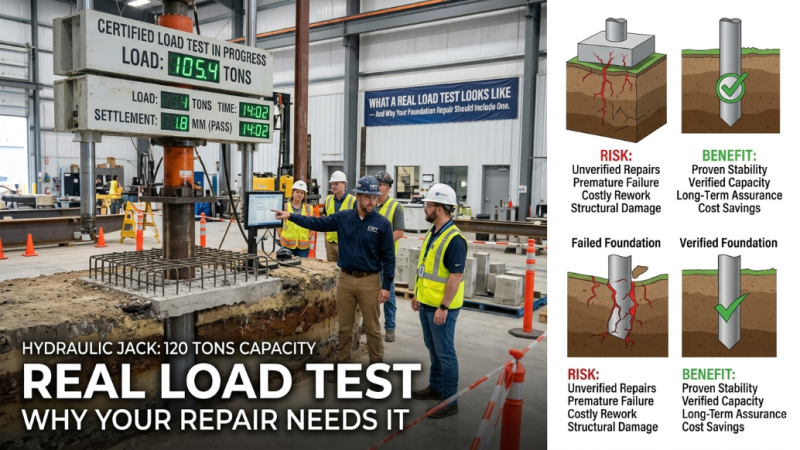
If a contractor drives or screws a pile into the ground under your settling foundation and then simply hands you an invoice, you should ask one question: How do you know it will hold?
On Long Island, that question matters more than most homeowners realize. Our ground is a patchwork of glacial outwash, marine clays, organic pockets, and reworked fill soils that can change strength dramatically within a few feet. A pile that "feels solid" going in isn't the same as a pile that has been proven to carry your home's load for the next several decades. The difference between the two is a load test.
Here's what a real one looks like, and why the best deep-foundation work always includes it.
The Problem: An Unverified Pile Is an Expensive Guess
Deep foundation repair helical piles, micropiles, push piers works by transferring the weight of your structure past weak near-surface soils down to a competent bearing layer. The engineering is sound. The risk is in the assumption: many installers rely on published capacity charts or a "feel" for the soil, install the piles, and leave. If the bearing layer wasn't where it was assumed to be, or the soil was weaker than the chart assumed, the settlement simply continues now with piles in the ground and a much bigger repair bill.
This isn't a fringe concern. Federal deep-foundation guidance treats the measured, physically tested capacity of a pile as the benchmark against which every predicted capacity is checked because predicted and actual capacity routinely differ once you're in real soil. The Federal Highway Administration's own analysis of static and dynamic pile load test data makes the point plainly: a load test is how you convert an estimate into a number you can trust.
For a homeowner, the translation is simple: assumed capacity protects the contractor's schedule; verified capacity protects your house.
The Solution: A Static Load Test That Physically Proves Capacity
A load test does something refreshingly literal it puts real, measured load on the pile and watches what happens. The industry-standard method is the static axial compressive load test defined by ASTM D1143, the specification engineers reference when they need proof rather than a promise.
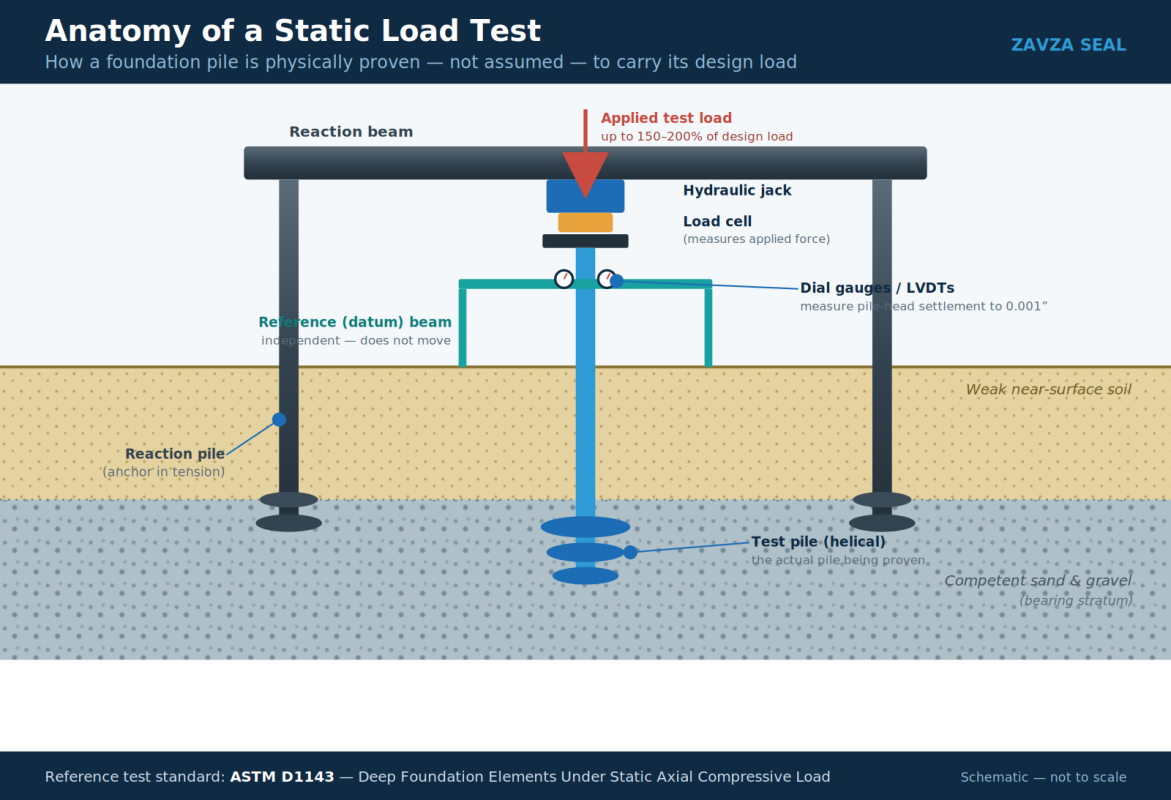
The setup is straightforward once you see it laid out. The pile being tested is loaded by a hydraulic jack that pushes against a heavy reaction beam, which is anchored down by reaction piles on either side. An inline load cell measures exactly how much force is applied. Independent dial gauges (or LVDTs) mounted on a separate reference beam one that does not move measure how far the pile head settles, down to a thousandth of an inch.
The load is applied in steps, typically up to 150200% of the pile's design working load, and held at each increment so the crew can record how the pile responds over time. In other words: we deliberately overload the pile, on purpose, in a controlled way, so that your actual house never has to find the pile's limit the hard way.
How to Read the Results
The output of the test is a loadsettlement curve, and it tells you almost everything at a glance.
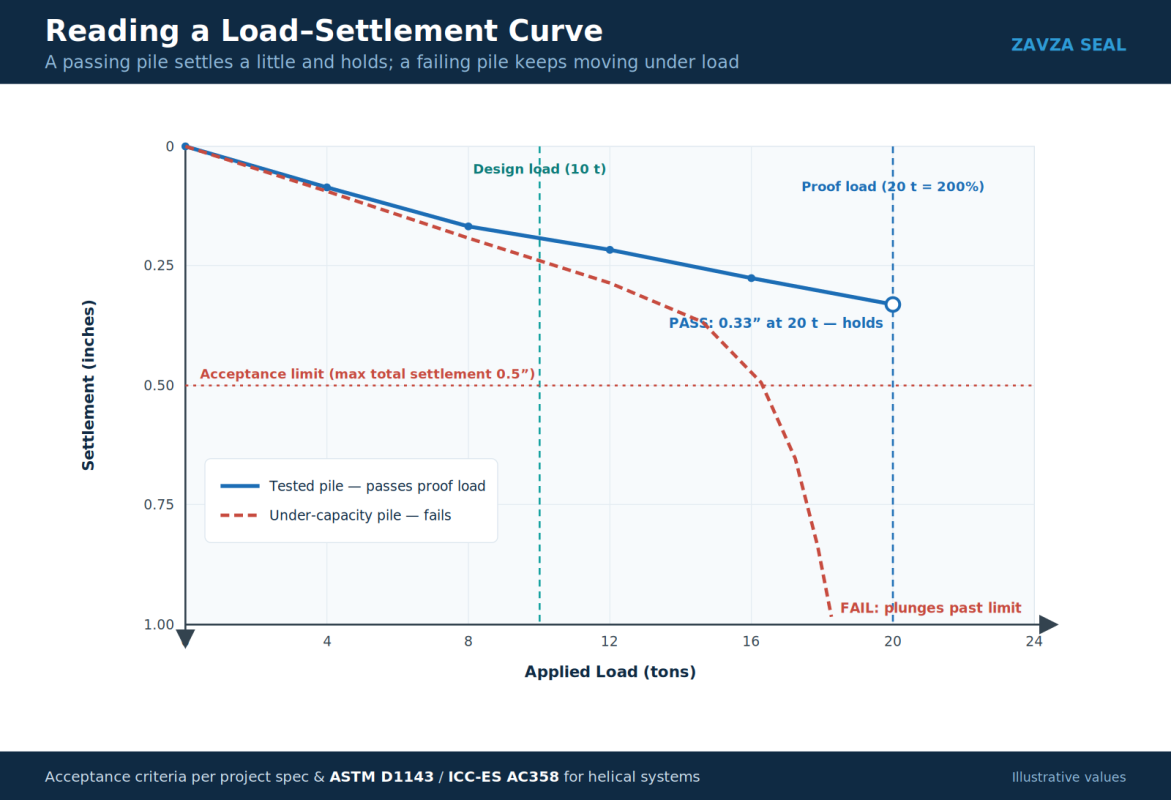
A pile that passes settles a small, predictable amount as load increases and then essentially holds steady the curve stays gentle and never crosses the project's acceptance limit for total or net settlement. A pile that's under-capacity behaves very differently: settlement accelerates and the curve "plunges" as the soil-pile system runs out of resistance. That plunge, captured on a test rig instead of under your living room, is exactly the failure you paid to avoid.
Acceptance criteria are set by the project engineer and the referenced standards, but the principle never changes: a little movement that stops is success; movement that keeps going is a warning.
Torque Tells Us in Real Time the Load Test Confirms It
For helical piles specifically, there's a second layer of quality control that happens during installation, not after. As the helical plates advance into stronger soil, the torque required to keep turning them rises and that installation torque correlates directly to the pile's ultimate capacity.
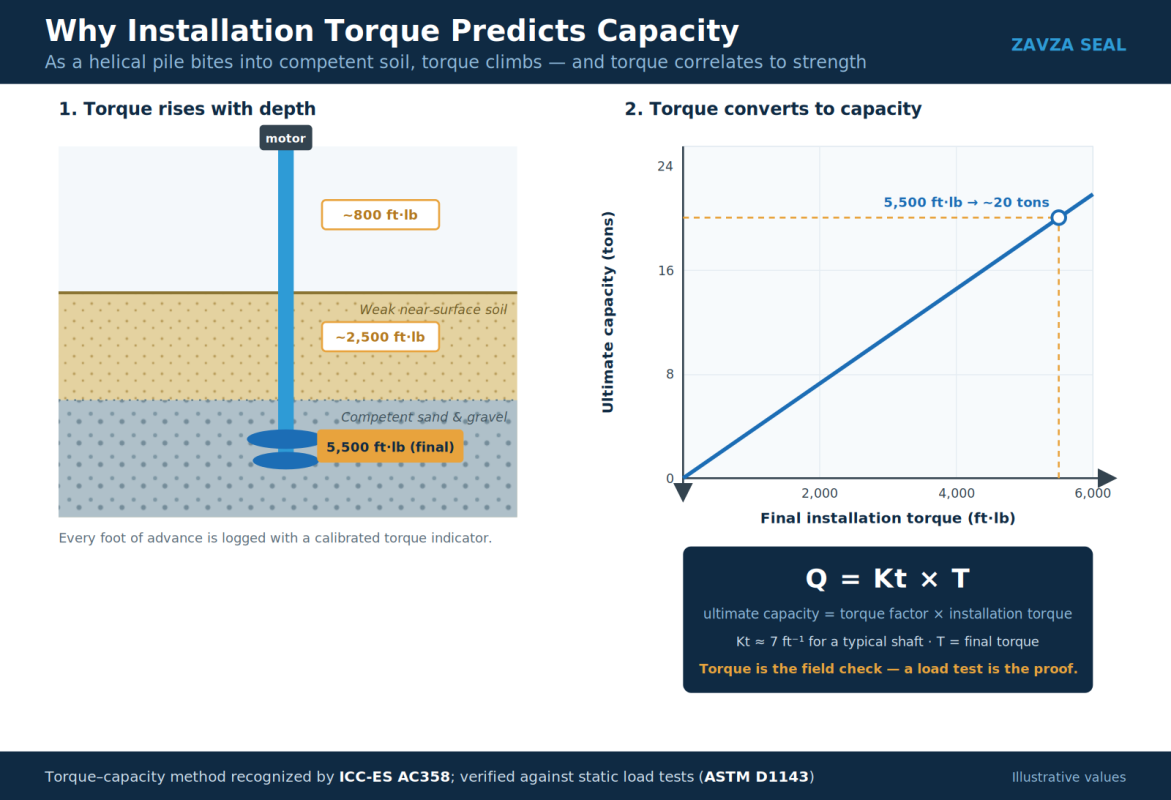
This relationship capacity a torque factor (Kt) times final installation torque is recognized in ICC-ES AC358, the acceptance criteria that govern helical pile systems. It means a properly equipped crew gets a real-time reading of capacity on every single pile as it goes in, logged foot by foot.
But torque is a field check, not final proof. The gold standard is to pair continuous torque monitoring on every pile with a full static load test on a representative pile the torque tells us the whole installation is behaving as designed, and the load test proves the number.
What This Means for Your Long Island Home
When we underpin a settling foundation, a leaning chimney, or a cracked basement wall, we don't want you taking our word for it and we don't want to take the soil's word for it either. That's why verified capacity is built into how we work: calibrated torque logging on every pile during installation, and static load testing to physically confirm the design, all documented so you have a permanent record of what your foundation can carry.
If you're weighing a foundation repair and want it done to a standard you can actually prove, this is the difference to look for. You can see how we approach pile load testing and soil testing before we ever install a pile, and learn more about our full range of waterproofing, concrete, and foundation work at ZavzaSeal.com.
The Bottom Line
A pile is only as good as your ability to prove it. A real load test turns "it should hold" into "here's the documented capacity, tested to twice the working load, with the curve to show it." On Long Island's variable soils, that proof isn't a luxury it's the whole point.
If your home is showing signs of settlement sticking doors, stair-step cracks, a separating chimney, or sloping floors the right first move is an assessment that includes proper testing. Talk to our team about a load-tested foundation solution built for the ground under your house.
Zavza Seal
www.zavzaseal.com
Call: +1(631) 980-1800
Categories
Deep Excavations, Pile Foundations, Deep Foundations, Rammed Aggregate Piers, Shear Strength of Underground Materials
Keywords
Lateral loading, pile load testing, pile foundations, load testing