
Published: 30 September 2026
Self-drilling grouting anchor bolts are widely used in foundation reinforcement, excavation support, slope stabilization, tunneling, and other ground engineering applications. Because drilling, anchoring, and grouting can be integrated into a single installation process, self-drilling anchor systems are particularly useful in fractured rock, loose ground, and other challenging geological conditions.
However, the performance of a self-drilling anchor system depends not only on the anchor bar itself. Material quality, manufacturing control, drilling parameters, grouting procedures, and anchorage geometry can all affect the final anchoring performance.
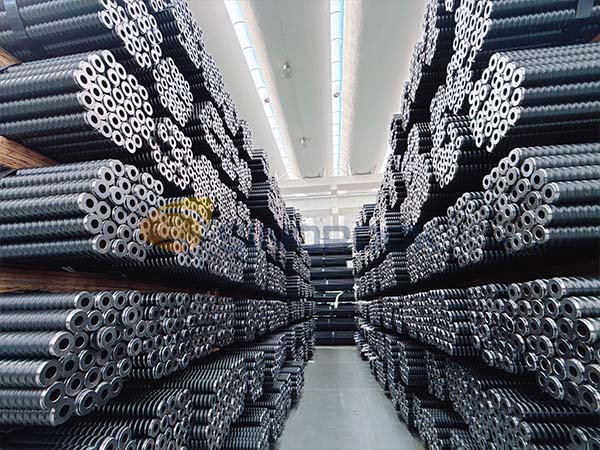
1. Key Factors in Self-Drilling Anchor Bolt Quality Control
1.1 Quality Inspection Standards
Establishing clear quality inspection requirements is the foundation of self-drilling anchor bolt quality control. Manufacturers should implement a systematic Quality Control process covering raw materials, production, inspection, and testing.
The inspection process should cover the key components of the anchoring system, including the hollow anchor bar, couplers, nuts, bearing plates, and drill bits. Depending on project requirements, inspections may include dimensional checks, thread inspection, mechanical testing, surface treatment inspection, and verification of material certificates.
A documented quality management system, such as ISO 9001. can provide a structured framework for controlling production and inspection processes.
For projects with specific technical requirements, the applicable product standards, project specifications, and mechanical performance requirements should be defined before production.
1.2 Raw Material Control
Product quality starts with the raw materials.
For hollow self-drilling anchor bars, important factors include the chemical composition and mechanical properties of the steel, dimensional accuracy, hollow section geometry, and consistency between production batches.
A systematic supplier evaluation process can help control these risks. Suppliers can be assessed based on their qualifications, manufacturing capabilities, material traceability, and quality management procedures.
Incoming material inspection should also be carried out before production. This helps ensure that the steel and other components meet the specified requirements before they enter the manufacturing process.
1.3 Manufacturing Process Control
The manufacturing process has a direct influence on the dimensional accuracy and mechanical performance of self-drilling anchor bolts.
Important control points may include:
- Hollow bar forming and rolling
- Thread dimensional accuracy
- Coupler and nut machining
- Heat treatment, where applicable
- Surface treatment and corrosion protection
- Dimensional inspection
- Mechanical performance testing
- Batch traceability
A multi-stage inspection process can further reduce production risks. For example, manufacturers may implement self-inspection, mutual inspection, and dedicated quality inspection during different production stages.
For critical projects, representative samples from different production batches can be tested to verify tensile strength, yield strength, elongation, and other specified properties.
2. Factors Affecting the Quality of the Anchorage
Even when the anchor bolts meet the required manufacturing specifications, the final anchoring performance also depends heavily on the installation and grouting process.
Two important factors are grouting quality and the geometry of the grouted anchorage body.
2.1 Grouting Quality and Re-Grouting
Grouting is an essential part of a self-drilling anchoring system. The grout transfers load between the hollow anchor bar and the surrounding ground while also filling voids and fractures around the borehole.
During drilling, grout can be pumped through the hollow anchor bar and discharged through openings near the drill bit. This process can help remove drilling cuttings and fill fractures or voids around the borehole.
For certain ground conditions and project requirements, re-grouting or secondary grouting can be considered to improve grout filling and anchorage performance.
A typical grouting sequence may include:
Primary grouting:
Grout is injected during drilling. A relatively fluid grout mix can facilitate drilling spoil removal and penetration into fractures and voids.
Secondary grouting:
After reaching the designed drilling depth, additional grout can be injected under controlled pressure to improve filling around the anchor and increase the integrity of the grouted body.
The actual water-cement ratio, injection pressure, grout volume, and grouting sequence should be determined according to the ground conditions, design requirements, and applicable project specifications rather than using a single fixed value for every project.
2.2 Diameter and Geometry of the Grouted Anchorage Body
The geometry of the grouted body is another important factor affecting anchoring performance.
The load transfer mechanism involves interaction between the anchor bar, grout body, and surrounding soil or rock. The grout surrounding the hollow anchor bar increases the effective diameter of the anchorage body and provides a larger interface for load transfer.
The final anchorage performance can therefore be affected by:
Borehole diameter
Grout body diameter
Grout strength
Grout-rock or grout-soil bond
Anchor bar surface and thread geometry
Ground conditions
Effective bonded length
In fractured or highly permeable ground, grout may migrate into surrounding fractures, making actual grout consumption and the final grouted geometry different from the theoretical borehole dimensions. Proper control of drilling and grouting parameters is therefore important.
3. Other Components That Should Not Be Overlooked
Quality control should cover the complete self-drilling anchoring system, rather than focusing only on the hollow anchor bar.
Couplers
Couplers connect individual hollow anchor bars when longer anchoring lengths are required. Their mechanical performance should be compatible with the anchor bars, and the connection should provide sufficient load-bearing capacity for the designed system.
Centralizers
Centralizers help maintain the position of the anchor bar within the borehole. Proper positioning can help achieve a more uniform grout layer around the bar and improve grout coverage.
Drill Bits
The drill bit must be selected according to the ground conditions and required borehole diameter. Appropriate bit selection can affect drilling efficiency, borehole quality, and grout distribution.
Bearing Plates and Nuts
Bearing plates and nuts transfer the load from the anchor system to the supported structure or ground surface. Their dimensions and mechanical properties should be matched to the anchor bar and the design load.
4. Quality Control from Manufacturing to Installation
The quality of a self-drilling grouting anchor system is not determined by one single factor. It is the result of continuous control throughout the entire process, from material selection and manufacturing to drilling, grouting, and final load transfer.
For engineering projects, the quality requirements should be established according to the geological conditions, design loads, installation method, applicable standards, and project specifications.
A properly controlled self-drilling anchoring system can provide reliable load transfer while simplifying installation in difficult ground conditions. For this reason, both product quality and installation quality should be considered when evaluating the overall performance of a self-drilling grouting anchor system.
Categories
Slope Stabilization
Keywords
Self-Drilling Grouting Anchor Bolts, Quality Control