
Published: 31 October 2026
1. Introduction
Self-drilling hollow bars are widely used in geotechnical engineering for ground reinforcement, slope stabilization, excavation support, tunnel pre-support, and foundation applications. By combining drilling, reinforcement installation, and grouting into a single operation, the self-drilling anchor system provides an efficient solution for stabilizing soil and rock, particularly in loose, fractured, or unstable ground conditions.
Unlike conventional anchoring methods, which generally require a separate drilling operation followed by the insertion of an anchor bar, self-drilling hollow bars serve as both the drilling rod and the permanent reinforcing element. A sacrificial drill bit is attached to the leading end of the hollow bar, while grout is pumped through its internal bore during drilling.
Once installation is completed, the grout surrounds the bar and forms a bond with the surrounding ground. Together, the hollow bar and hardened grout create a reinforced anchoring element that transfers loads between the supported structure and the surrounding soil or rock.
Although the basic installation principle remains similar, the working mechanism and load-bearing behavior vary depending on the engineering application. Understanding these differences is essential for selecting the appropriate self-drilling anchor system and achieving reliable ground reinforcement.
2. How Does a Self-Drilling Hollow Bar Work?
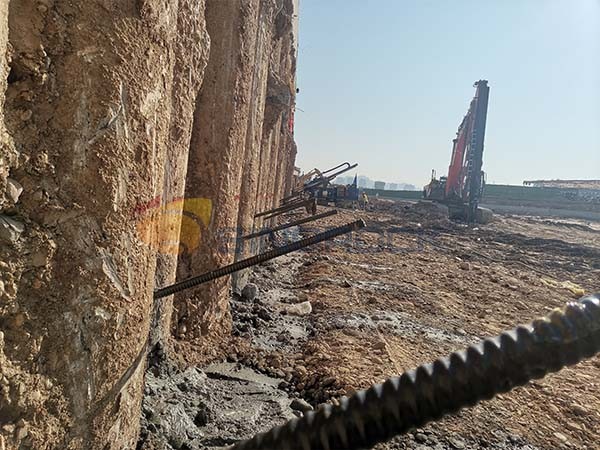
The working principle of a self-drilling hollow bar is based on the combined action of mechanical drilling, grout injection, and ground anchorage.
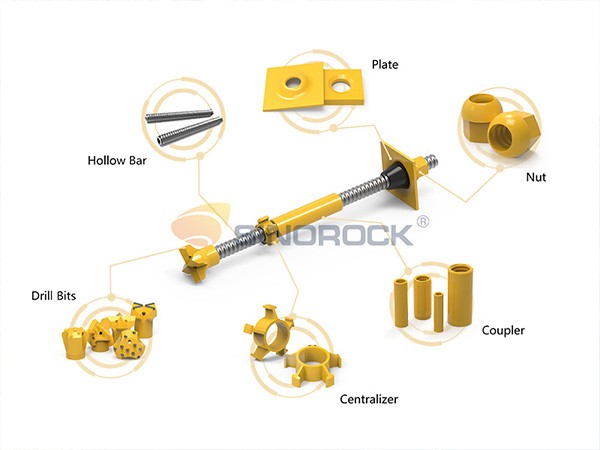
The system generally consists of a threaded hollow anchor bar, a sacrificial drill bit, a coupling sleeve (when required), a centralizer, a bearing plate, and a nut. Depending on the ground conditions and project requirements, additional accessories and installation equipment may be used.
2.1 Drilling and Installation
The hollow anchor bar functions as the drill rod, with a sacrificial drill bit installed at its front end. The drilling rig applies rotational and, where required, percussion energy to advance the bar into the ground.
As drilling progresses, additional hollow bar sections can be connected using threaded couplers to achieve the required installation length.
Because the anchor bar remains in the ground after installation, there is no need to withdraw the drilling rod and insert a separate reinforcement element.
2.2 Simultaneous Grouting
During drilling, grout is pumped through the internal hollow channel of the anchor bar toward the drill bit.
The grout exits through the flushing openings in the drill bit and flows into the space surrounding the bar. Depending on the ground conditions, drilling method, and grout pressure, it can fill the annular space and penetrate available voids or fractures in the surrounding ground.
This process helps stabilize the borehole during installation and establishes contact between the grout, anchor bar, and surrounding soil or rock.
Cement grout or cement-based grout is commonly used, with the mix design determined according to project specifications and ground conditions.
2.3 Formation of the Anchoring Body
After grouting, the cement-based material hardens around the hollow bar, forming a composite anchoring element.
The hardened grout provides a load-transfer interface between the steel bar and the surrounding ground. The continuous external thread of the hollow bar also provides mechanical engagement with the grout.
The resulting anchoring body combines the tensile capacity of the steel bar with the bond resistance developed along the grout-ground interface.
2.4 Load Transfer and Ground Reinforcement
When the surrounding ground deforms or an external load acts on the supported structure, tensile or compressive forces may develop in the anchoring element, depending on the system configuration and structural design.
For tension-loaded applications, the load is transferred through the following components:
-
The bearing plate receives the load from the supported structure or ground-facing system.
-
The nut transfers the load from the bearing plate to the hollow anchor bar.
-
The hollow bar carries the axial tensile force.
-
The hardened grout transfers the force through bond stresses to the surrounding soil or rock.
The interaction between the anchor bar, grout, and surrounding ground creates a reinforced system that improves the stability and load-bearing performance of the ground.
The effectiveness of this load-transfer mechanism depends on factors such as bar tensile capacity, grout properties, bond strength, embedment length, ground conditions, and installation quality.
3. Working Principles in Different Engineering Applications
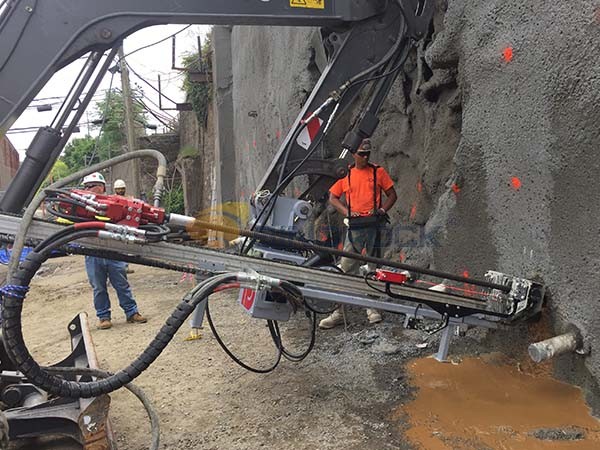
Self-drilling hollow bars can be used in various geotechnical applications. However, their structural behavior and load-transfer mechanisms depend on the specific engineering purpose.
3.1 Slope Stabilization
Slope stabilization is one of the major applications of self-drilling hollow bar systems.
In unstable slopes, soil or rock masses may move or deform under the influence of gravity, groundwater, weathering, excavation, or other external factors. Self-drilling anchors reinforce the ground by creating additional tensile resistance and improving the interaction between individual soil or rock masses.
Installation Process
Self-drilling hollow bars are installed into the slope at predetermined angles and depths using a suitable drilling rig. During drilling, grout is simultaneously injected through the hollow bar and discharged through the drill bit.
After the required installation depth is reached, the anchor head assembly, generally consisting of a bearing plate and nut, is installed against the slope surface.
Once the grout has hardened, the hollow bar and surrounding grout form an anchoring element embedded in the ground.
Working Principle
When the slope tends to deform or slide, tensile forces develop in the reinforcing elements through their interaction with the moving ground mass.
These forces are transferred along the grout-ground interface through bond stresses. The anchors help restrain relative movement between soil or rock layers and contribute to the overall stability of the reinforced slope.
When combined with suitable surface protection, drainage measures, and facing systems, self-drilling anchors can provide effective reinforcement for slopes with challenging geological conditions.
Typical Applications
-
Soil slope reinforcement
-
Rock slope stabilization
-
Landslide mitigation
-
Cut slope protection
-
Weathered and fractured rock reinforcement
3.2 Excavation Support
Self-drilling hollow bars can also be used in excavation support systems to reinforce soil and rock surrounding excavated areas.
During excavation, the removal of supporting material can cause stress redistribution and deformation in the retained ground. Without adequate reinforcement, excessive movement may affect adjacent structures and underground utilities.
Self-drilling hollow bars can be installed as soil nails or ground anchors, depending on the structural design and intended load-bearing mechanism.
Installation Process
The hollow bars are drilled into the retained soil or rock at specified inclinations and spacing. Grout is injected through the hollow bar during drilling, filling the surrounding space and forming a bonded anchoring element after hardening.
After installation, the anchor heads are connected to a suitable facing system, such as shotcrete, bearing plates, or reinforced concrete facing, depending on the project design.
Working Principle
In conventional soil nailing systems, the reinforcing elements are generally passive. As the retained ground deforms, tensile forces develop in the nails. These forces are transferred to the surrounding ground through shear stresses along the grout-ground interface.
The interaction between the soil nails and the facing system creates a reinforced soil mass that improves overall stability and limits ground deformation.
In contrast, when the design requires prestressed ground anchors, the installed elements are tensioned and locked off to introduce an active anchoring force before significant ground movement occurs.
Therefore, the distinction between soil nails and prestressed ground anchors should be considered when selecting and designing a self-drilling hollow bar system.
Typical Applications
-
Deep excavation support
-
Temporary retaining structures
-
Soil nail walls
-
Foundation pit reinforcement
-
Retaining wall stabilization
3.3 Tunnel Pre-Support
Tunnel excavation in weak, fractured, or unstable ground can cause ground loosening, excessive deformation, and potential collapse around the tunnel face and crown.
Tunnel pre-support systems are used to reinforce the ground ahead of excavation, helping maintain stability during subsequent excavation and primary support installation.
Self-drilling hollow bars can be used in tunnel pre-support applications, including self-drilling spiles and pipe umbrella systems, depending on the design configuration.
Installation Process
Self-drilling bars or pipes are installed around the tunnel crown, generally following a predetermined arrangement and inclination.
Using a suitable drilling rig, the elements are advanced into the ground while grout is pumped through their internal channels.
The drilling and grouting operations are completed in a coordinated process, reducing the need for separate borehole drilling and reinforcement insertion.
After installation and grout hardening, the reinforced elements form a supporting zone ahead of the excavation face.
Working Principle
The installed elements reinforce the ground surrounding the tunnel crown and help create a more stable load-bearing structure.
In pipe umbrella systems, overlapping or closely spaced longitudinal elements form a reinforced canopy ahead of the excavation face. This canopy helps redistribute loads around the unsupported excavation area and reduces ground deformation.
In self-drilling spile applications, the reinforcing elements provide localized pre-support to improve the stability of the ground during excavation.
These systems are particularly useful where conventional drilling methods may encounter borehole collapse, difficult ground conditions, or problems inserting separate support elements after drilling.
Engineering Benefits
-
Combines drilling and grouting into a coordinated installation process.
-
Reduces the risk of borehole instability during installation.
-
Helps reinforce weak and fractured ground ahead of excavation.
-
Improves construction continuity and installation efficiency.
-
Helps control ground deformation and reduce the risk of collapse.
Typical Applications
-
Tunnel crown reinforcement
-
Tunnel face pre-support
-
Pipe umbrella systems
-
Weak and fractured rock tunnels
-
Tunneling in loose overburden
3.4 Micropile Foundations
Self-drilling hollow bars can also be used in micropile systems for foundation reinforcement and load transfer.
Micropiles are small-diameter, grouted foundation elements that transfer structural loads into deeper or more competent ground. Self-drilling hollow bar systems offer an installation solution where conventional drilling and casing operations may be difficult or inefficient.
Installation Process
A hollow anchor bar fitted with a suitable drill bit is advanced into the ground using a drilling rig.
During installation, grout is pumped through the internal channel of the bar and discharged near the drill bit. Additional bar sections can be connected when greater installation depths are required.
After reaching the specified depth, grouting is completed according to the project requirements. The hardened grout surrounding the bar forms a composite foundation element.
Working Principle
Under structural loading, micropiles transfer loads through the interaction of the steel reinforcement, grout body, and surrounding ground.
For compression-loaded micropiles, structural loads are transferred through the pile to the surrounding ground, primarily through shaft resistance and, where applicable, end-bearing resistance.
For tension-loaded applications, the bond between the grout body and surrounding ground provides resistance against uplift.
The actual load-transfer mechanism depends on the micropile configuration, geological conditions, reinforcement design, and foundation requirements.
Typical Applications
-
Building foundation reinforcement
-
Foundation underpinning
-
Existing structure rehabilitation
-
Ground improvement
-
Tension and compression foundation elements
4. Prestressed Self-Drilling Ground Anchors
In certain engineering projects, self-drilling hollow bars may be incorporated into prestressed ground anchor systems.
Unlike conventional passive soil nails, prestressed ground anchors are designed to introduce an initial tensile force into the anchoring system through stressing and lock-off.
Working Principle
The hollow bar is installed and grouted according to the specified anchoring design. After the grout has achieved the required strength, the anchoring system is stressed using suitable equipment.
The applied tensile force is transferred through the anchorage assembly to the supporting structure, while the bonded anchorage zone transfers the force into the surrounding ground.
This creates an active anchoring effect that helps resist external loads and control structural or ground movement.
Prestressed self-drilling hollow bar anchors require particular attention to the design of the free length, bonded length, anchorage components, stressing procedure, and load testing.
Not every self-drilling hollow bar installation is suitable for prestressing. The system must be specifically designed and verified for the intended stressing requirements.
5. Key Factors Affecting Self-Drilling Anchor Performance
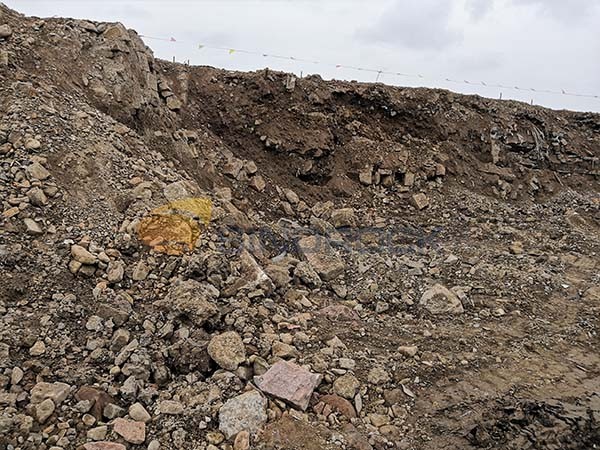
The performance of a self-drilling hollow bar system depends not only on the steel bar itself but also on the interaction between the entire anchoring system and the surrounding ground.
Several factors should be considered during system selection and installation.
1. Ground Conditions
Soil type, rock strength, geological discontinuities, groundwater, and borehole stability all influence drilling performance and anchorage behavior.
2. Grout Properties
Grout strength, water-cement ratio, workability, setting characteristics, and injection conditions affect the quality of the anchoring body and its bond with the surrounding ground.
3. Anchor Bar Specifications
Bar diameter, steel grade, tensile capacity, thread configuration, and connection strength must satisfy the structural requirements of the project.
4. Installation Parameters
Drilling speed, rotational and percussion energy, flushing conditions, grout pressure, and grout flow rate should be controlled according to the ground conditions and installation method.
5. Corrosion Protection
For permanent applications, corrosion protection must be selected according to the service life, environmental exposure, and project specifications. Appropriate protection systems may include hot-dip galvanizing, epoxy coatings, or dual-corrosion protection systems.
6. Quality Control and Testing
Installation records, grout consumption, drilling parameters, material inspections, and applicable load tests should be considered to verify installation quality and system performance.
6. Why Choose a Self-Drilling Hollow Bar System?
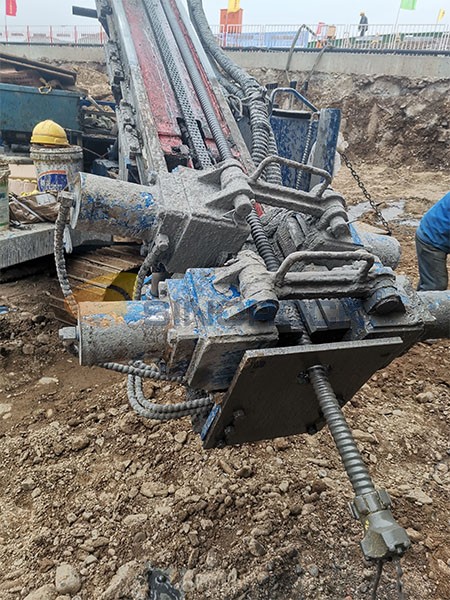
Compared with conventional drilling and anchoring methods, self-drilling hollow bar systems offer several practical advantages.
Drilling and Grouting in One Operation
The hollow bar serves as both the drilling rod and permanent reinforcement, while grout is injected through its internal channel during drilling. This eliminates the need for a separate reinforcement insertion operation.
Suitable for Unstable Ground Conditions
The simultaneous drilling and grouting process helps reduce the risk of borehole collapse and facilitates installation in loose, fractured, or weak ground.
Flexible Installation Length
Threaded hollow bars can be connected using couplers to achieve the required installation length, providing flexibility for different project conditions.
Efficient Load Transfer
The combination of a steel reinforcement bar and hardened grout creates an anchoring element that transfers loads between the structure and surrounding ground.
Versatile Engineering Applications
With appropriate system configurations, self-drilling hollow bars can be used in slope stabilization, excavation support, tunnel pre-support, micropile foundations, and other ground reinforcement applications.
7. FAQ
Q1: What is the working principle of a self-drilling hollow bar?
A self-drilling hollow bar works by combining drilling, reinforcement installation, and grouting. During drilling, grout is pumped through the hollow center of the bar and discharged through the drill bit. After hardening, the grout bonds the bar to the surrounding ground, forming an anchoring element that transfers loads between the structure and the soil or rock.
Q2: What is the difference between a self-drilling hollow bar and a conventional anchor bolt?
A conventional anchor bolt generally requires a pre-drilled borehole before the reinforcement is installed. A self-drilling hollow bar serves as both the drilling rod and permanent reinforcement, allowing drilling and grouting to be carried out in a coordinated operation. This makes it particularly suitable for unstable ground conditions where borehole collapse may occur.
Q3: Can self-drilling hollow bars be used in both soil and rock?
Yes. Self-drilling hollow bars can be used in various soil and rock conditions, including loose overburden, weathered rock, and fractured rock masses. However, the drill bit, drilling parameters, grout properties, and anchor specifications should be selected according to the actual geological conditions.
Q4: Are self-drilling hollow bars always prestressed?
No. Many self-drilling hollow bar installations work as passive reinforcement elements, such as soil nails. Prestressing is only applicable when the anchoring system is specifically designed for tensioning and lock-off, with suitable anchorage and bonded-length arrangements.
Q5: What factors determine the load-bearing capacity of a self-drilling hollow bar?
The load-bearing capacity depends on several factors, including the tensile strength of the steel bar, grout strength, bond resistance between the grout and surrounding ground, installation length, ground conditions, and connection capacity. Project-specific design calculations and testing are necessary to establish the allowable or design resistance.
8. Conclusion
Self-drilling hollow bar systems provide an integrated solution for ground reinforcement by combining drilling, grouting, and permanent reinforcement installation.
Through the interaction of the hollow steel bar, hardened grout, and surrounding soil or rock, these systems help improve ground stability, transfer structural loads, and control deformation in a wide range of geotechnical applications.
From slope stabilization and excavation support to tunnel pre-support and micropile foundations, the appropriate self-drilling hollow bar configuration can be selected according to the specific engineering requirements and ground conditions.
With extensive experience in self-drilling anchor manufacturing, Sinorock provides self-drilling hollow bar systems and matching accessories for a wide range of geotechnical applications. Our product range supports different engineering requirements, helping distributors and project material suppliers provide reliable anchoring solutions for their markets.
Contact Sinorock to discuss your self-drilling hollow bar requirements and find a suitable system for your project.
Categories
Deep Excavations, Retaining Walls, Pile Foundations, Landslides, Slope Stabilization, Jacked Tunnels
Keywords
Self-Drilling Anchor System, Self-Drilling Hollow Bar Applications, Slope Stabilization, Excavation Support, Tunnel Pre-Support, Self-Drilling Micropiles